Fictional crimes unfold against the very real landscapes and communities of southwestern Montana.
Where Fiction Meets the Montana Landscape
Lynden Sears approaches mystery writing from an unusual perspective: he often begins without knowing precisely where the story will end.
An opening idea becomes a scene. The scene becomes a sequence of events. Characters respond, clues emerge, and the story develops naturally as Lynden imagines himself standing alongside the people he is writing about.
What remains constant throughout his novels is the setting.
The crimes and characters are fictional, but the geography is grounded in reality. Roads, communities, rivers, distances, and landscapes are drawn from the southwestern Montana Lynden has known for decades.
At the center of the stories is Sheriff Phillip Chandler, but surrounding him is another presence just as important: Montana itself.
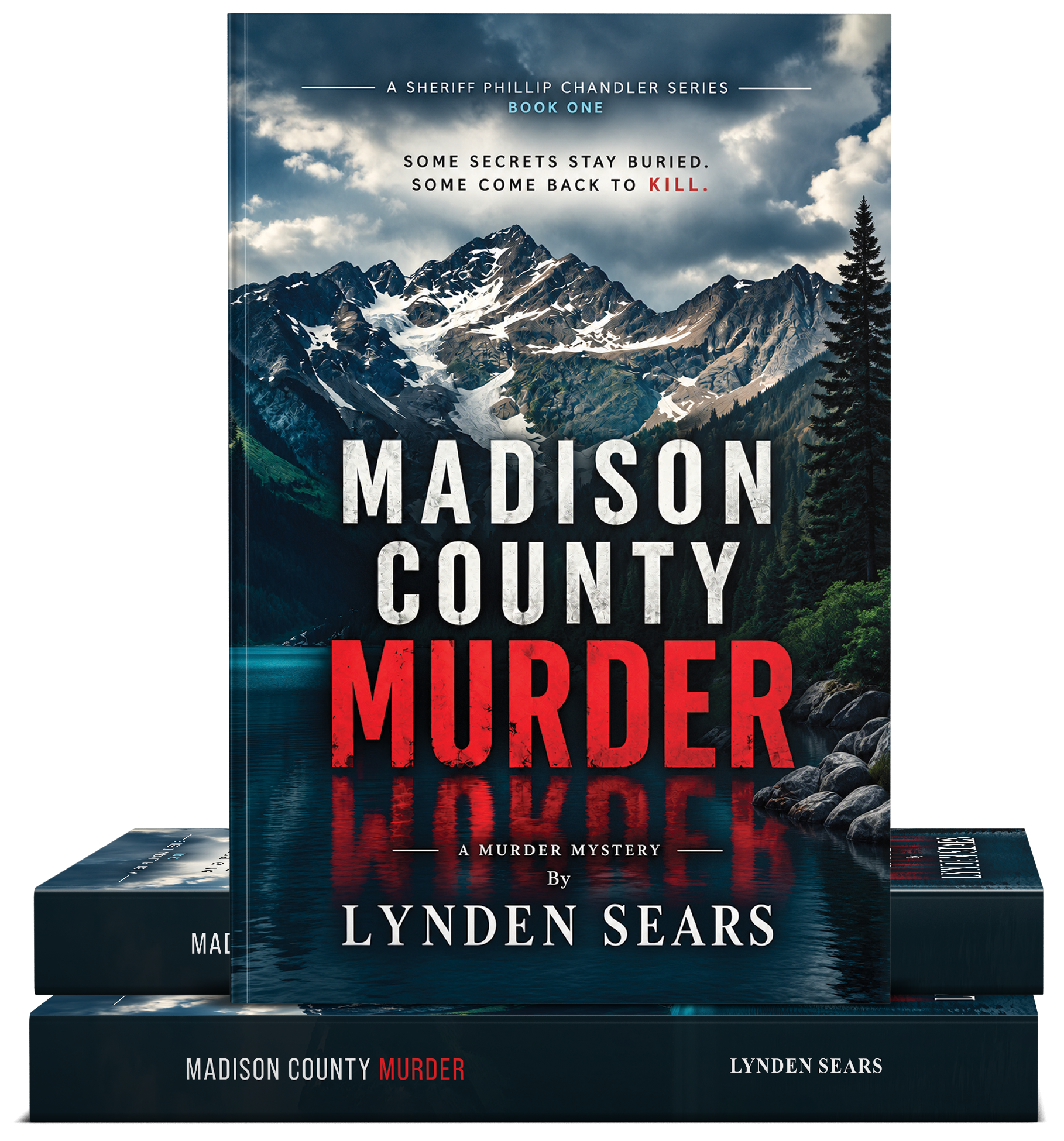
Madison County Murder
Madison County Murder began in the mid-1990s while Lynden was away from home on an extended Postal Service assignment in Norman, Oklahoma. During his evenings at the hotel, he began developing the story that would introduce Sheriff Phillip Chandler.
Lynden constructed the mystery around a sequence of clues intended to lead readers toward the possibility that the perpetrator was someone remarkably close to the sheriff.
The novel also contains deeply personal connections hidden within its fictional cast.
The first names of the principal characters were drawn from Lynden’s seven sons. Sheriff Phillip Chandler carries the first name of Lynden’s deceased son, while Chandler comes from the surname of one of his closest Army friends.
After completing the manuscript, Lynden attempted to find a traditional publisher. A succession of rejection letters eventually led him to put the project aside for roughly two decades.
Years later, he returned to the manuscript and pursued publication again. That decision ultimately revived not only Madison County Murder, but also Lynden’s desire to continue Sheriff Chandler’s story.
Jefferson County Murder: Cold Case
With his first novel moving toward publication, Lynden returned to an idea that had remained in his imagination for years.
That idea became Jefferson County Murder: Cold Case.
The earliest scenes had lived in his mind long before he knew where they would eventually lead Sheriff Chandler. Lynden began writing those scenes and allowed the story to reveal itself chapter by chapter, seldom knowing more than a few chapters ahead what direction the investigation would take.
One aspect of the story was influenced by a painful experience from Lynden’s working years. A friend and co-worker had been brutally murdered. Although the circumstances and cause of death in the novel differ from the real event, the motive behind that tragedy influenced the central theme Lynden explored while developing the fictional case.
The result continues the Sheriff Chandler stories while remaining firmly connected to the landscapes and experiences that inform Lynden’s writing.
Beaverhead County Murder
The idea behind Beaverhead County Murder also remained with Lynden for years before becoming a novel.
Once again, he began with a persistent opening thought rather than a predetermined ending. Chapter One provided the starting point, and the rest of the story developed as he wrote.
A small connection to Lynden’s past lies behind the setting of the story. During his teenage years, a close friend’s body was recovered from the Jefferson River approximately 60 miles downstream from where the fictional victim is discovered in the novel. Lynden makes clear that the causes of death are entirely different; the real event serves only as a distant connection to a landscape and memory he knew personally.
The novel also draws upon another part of Lynden’s experience: more than four decades working for and alongside federal agencies.
That background gave him an understanding of the ways federal, state, and county organizations work together toward shared objectives. He uses that knowledge to portray interagency cooperation with greater authenticity within the story.
Sheriff Chandler and the Real Southwest Montana
Across the novels, Sheriff Phillip Chandler provides continuity, but the series is equally defined by its sense of place.
Lynden writes about locations he knows. Geography is not treated merely as scenery behind the action. Mountains, rivers, roads, communities, and distances influence how the stories unfold.
His decades in Montana, work with government agencies, brief experience in a sheriff’s office, outdoor pursuits, travels, friendships, and family memories collectively provide a reservoir of experience from which the fictional world can grow.
Readers encounter invented mysteries, but they travel through a landscape that is very real.
For Lynden, that combination is at the heart of the series: imagined stories unfolding in places that can actually be found on a map. Learn more about the man and experiences behind the novels by visiting The Author.